
If you’ve had a “free hearing screening” at a pharmacy, a physician’s office, or a health fair, you’ve probably walked away with one of two words: pass or fail. That’s actually by design, and understanding why can help you make better decisions about your own hearing care.
Medicare draws a hard line between a hearing screening and a diagnostic audiologic evaluation, and it’s not a technicality. It’s the difference between “does your hearing need further investigation” and “here is exactly what’s happening in your ears, how your brain interprets that information, and what we should do about it.”
Screenings and What They Measure
We’ve all seen the signs at community health fairs promoting free hearing tests. We even participated in one on October 22 in Troy! They are very convenient, but they are not designed to diagnose hearing loss. A screening is nothing more than a quick pass-or-fail check. It doesn’t explain why you’re struggling, what is causing the change, or how your ears are functioning.
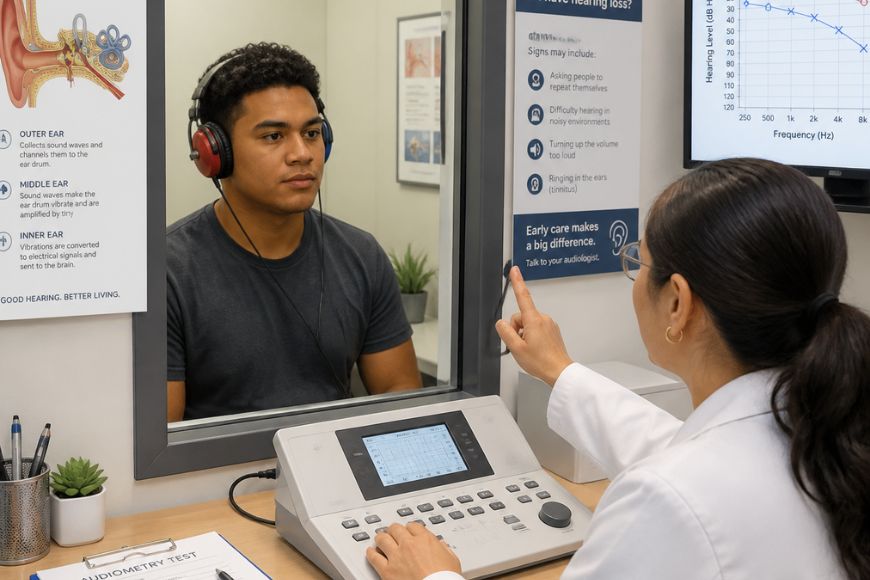
The process is very simple. You wear headphones, you hear a few beeps at a few pitches, and you raise your hand to indicate which ear is hearing a beep. If you hear enough of them, you pass. If you don’t, you’re told to schedule an appointment to get your hearing checked.
While they’re good for giving you that basic information, these screenings don’t include the tool that checks whether the sound is getting stuck somewhere in the middle ear or whether the problem is in the inner ear. It also doesn’t test how well you understand words, which is the thing many people actually struggle with. And because a screening doesn’t typically take place in a sound booth, only about 4-5 frequencies are tested in each ear.
How a Diagnostic Evaluation Differs
A full diagnostic audiologic evaluation is a medical exam of your hearing system, start to finish. At Inman Audiology, that means I look in your ears first, then check how your eardrum and middle ear are moving. Then we measure your actual hearing thresholds, ear by ear, pitch by pitch, both through headphones and through a small bone-conduction oscillator behind your ear. That second measurement is how we tell the difference between a permanent inner-ear loss and a middle-ear problem that a physician may be able to treat.
Next, we test speech. This is not just a “can you hear this?” test, but a “how many of these words can you repeat back correctly?” test, sometimes with background noise added. After all, that’s the world you live in and that’s what you’re being asked to do every single day! This helps us understand what your brain does with sound, not just what your ears can hear.
Take Charge of Your Hearing Health
October is Audiology Awareness Month, and it’s a great time to take a closer look at your hearing and your overall health. Hearing is part of whole‑body wellness; it’s not an add‑on or a luxury. Your hearing requires specific, ongoing management, just like vision or dental care!
At Inman Audiology, we specialize in diagnostic evaluations. Unlike a free hearing test, a diagnostic evaluation is a full medical appointment with a Doctor of Audiology. It includes:
- Case history
- Otoscopy (internal ear exam)
- Tympanometry (an eardrum test)
- Pure‑tone testing
- Speech testing
- Speech‑in‑noise testing
By performing all of these tests, we can do a much better job of identifying the type, degree, and cause of hearing loss. It’s also how we determine whether medical treatment is needed. A free screening inside a shopping center won’t be able to do any of this.
If you have questions about your insurance or Medicare, we can help! Our Patient Care Coordinators will verify your benefits, explain what’s covered, and help you understand your options before your appointment. We are also happy to unbundle services as needed, so you’re paying for care, not just hardware.
Call us at 248-839-5429 to schedule an appointment with us!